
Choosing Your Fabrics
Names Worth Knowing
A mill's name on a selvedge is a warranty written over generations. These are the houses we return to.
For Jackets
-
The French house, and the closest thing we have to a native tongue. Dormeuil is where the technical ambition lives: mohair blends with a dry crispness that resists creasing, cashmere ranges of genuine softness, cloths engineered to shed rain, and micron counts fine enough to be measured rather than described. If you want a cloth that does something particular, it usually begins here.
-
Breadth without loss of nerve. Business worsteds that survive a decade of daily wear; superfine cloths for the suits that need to whisper; Scottish tweeds with real weight and real history; and a formalwear range that understands black tie is not just a dark suit.
-
Among the oldest working mills in Europe. The reference point for a well-made Italian worsted: reliable, beautifully finished, and quietly excellent at the four-season weights that do the most work in a wardrobe.
-
Merino specialists. Fine, soft, superbly consistent — and the mill we reach for when a client wants Italian softness without Italian fragility.
-
Colour and character. Cerruti has never been the conservative choice, which is exactly its use: it is where a jacketing stops being a uniform and becomes a decision.
-
Texture and invention. Jacketings with surface interest, unexpected blends, cloths that reward being looked at twice.
-
Cotton, and the best of it. Corduroy with a defined wale, moleskin with a genuine nap, heavy cotton twills that soften with wear and improve for years. The foundation of every odd trouser worth owning.
For Shirtings
-
English shirting archive, Italian mill precision. The standard against which a dress shirt is measured.
-
Bergamo. Superfine cottons, exceptional finishing, and a depth of range that covers the whole week.
-
Weave-led. Where a shirt earns texture rather than pattern.
-
For the man tired of his own shirt drawer. The pattern work here is genuinely distinctive — the place to go when stripe and check have stopped being interesting.
Four Things Decide Everything
Fibre, weight, weave, finish. Learn these and you will never need a salesman.
Fibre
| Fibre | Qualities | Best for |
|---|---|---|
| Worsted wool | Smooth, fine, resilient. Takes a press and holds it. Recovers from a day in a chair. | The business wardrobe. The first suit. The suit worn most. |
| Flannel | Woollen-spun and brushed — soft, matte, warm, with a depth of colour worsted cannot reach. | Autumn and winter. Grey trousers that make everything else look better. |
| High-twist / fresco | Tightly twisted, open, springy. Breathes, resists creasing, refuses to look tired. | Summer suiting. Travel. Humid climates. Long days. |
| Mohair blend | Dry, crisp, faintly lustrous. Sheds wrinkles. Holds a sharp line in heat. | Warm-weather formality. Evening. The man who will not be seen rumpled. |
| Cashmere & blends | Soft, light, warm out of proportion to its weight. Luxurious hand. | Jacketings and overcoats. Indulgence with a purpose. |
| Wool–silk / wool–silk–linen | Subtle sheen, irregular texture, beautiful drape. | Summer jacketings. Weddings. Anything photographed. |
| Linen & blends | Cool, dry, and characteristically creased. | July. The coast. Relaxed tailoring only. |
| Cotton | Casual, matte, durable. Corduroy and moleskin soften into you. | Odd trousers. Unstructured jackets. Weekends. |
| Tweed & Shetland | Weighty, textured, hard-wearing, warm. Improves with age. | Country jackets. Overcoats. A garment for twenty years. |
| Technical / treated | Wool that repels rain without looking like it is trying to. | Travel. Commuting. Overcoating. |
Weight
Heavier cloth is not a compromise — it drapes better, wrinkles less, and lasts longer. Modern rooms are simply over-heated.
| Weight | Season | Character |
|---|---|---|
| 7–9 oz | High Summer | Light, breathable, needs care in the making. |
| 9–11 oz | Spring / Summer | The warm-weather standard. Comfortable, still tailorable. |
| 11–13 oz | Year-Round | The most versatile weight in tailoring. If you own one suit, own it here. |
| 13–16 oz | Fall / Winter | Drapes beautifully. Hangs clean. Feels like a garment. |
| 16 oz + | Deep Winter, Outerwear | Structure, warmth, permanence. |
Weave
Plain / hopsack — open, breathable, casual in effect. Good jacketing.
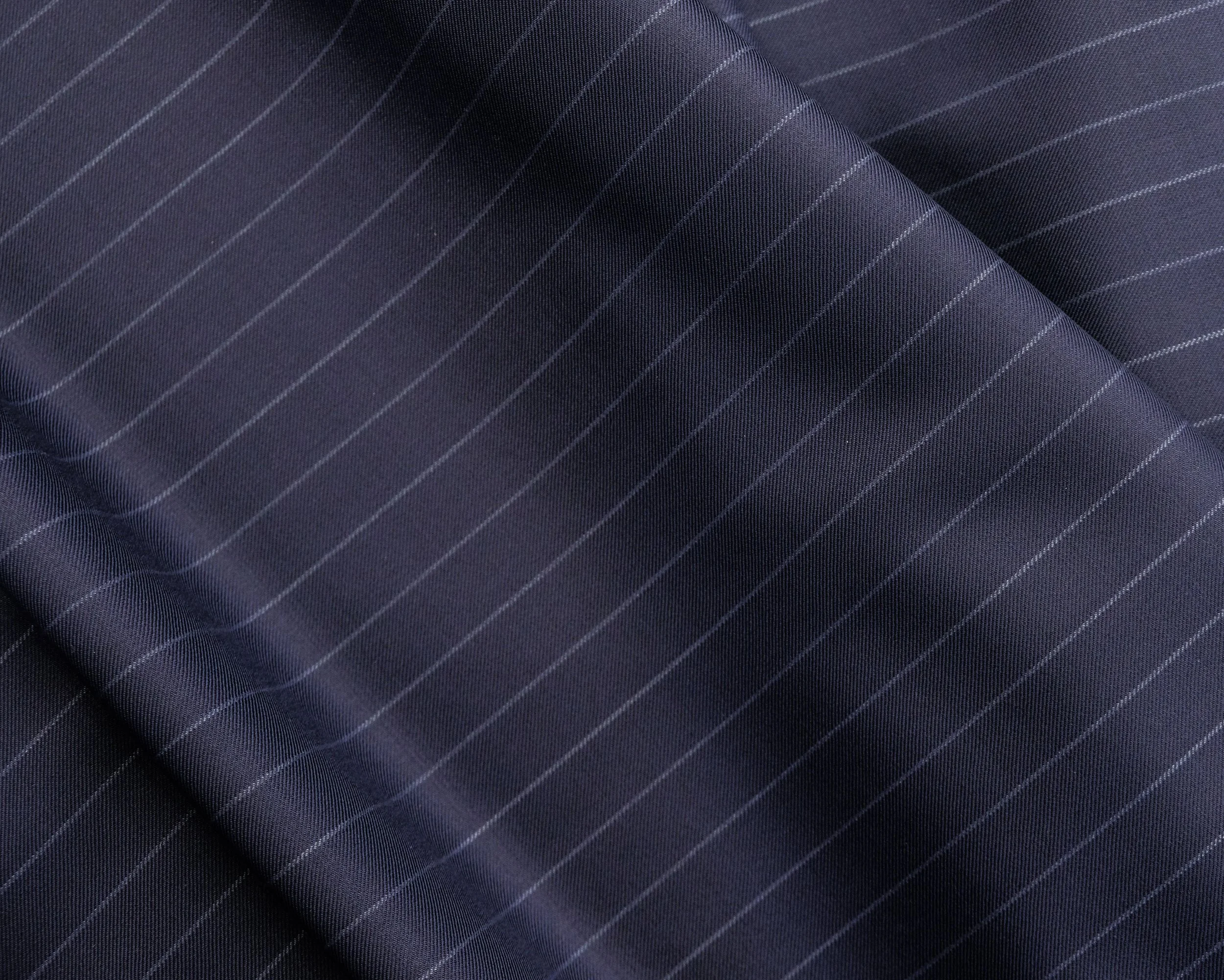
Twill — the diagonal line. Durable, drapes well, hides a day's wear.
Herringbone — twill reversed on itself. Texture without pattern. Endlessly wearable.
Birdseye & nailhead — micro-patterns that read as solid at three paces and reward a closer look. The intelligent alternative to plain navy.
Sharkskin — two-tone, subtly lustrous, quietly formal.
Barathea — dense, matte, pebbled. The correct cloth for evening.
Flannel & brushed — the surface, not the structure. Softness you can see.
Finish
Matte absorbs light and reads as serious.
Lustrous returns it and reads as evening.
Milled softens the hand.
Clear-finished keeps the weave visible and the line sharp — and wears longer.
Where To Start
If you know what the suit is for, We know where to look.
| You Need | Look For |
|---|---|
| A first suit, worn weekly | House Collection, 11–13 oz worsted, navy or charcoal. Vitale Barberis Canonico or Holland & Sherry. |
| A second suit that isn't the first | The same weight in a birdseye, nailhead, or subtle check. Different at close range, identical in authority. |
| Summer, and a full day in it | High-twist or mohair blend, 8–10 oz. Dormeuil or the Holland & Sherry warm-weather ranges. |
| A wedding — yours | Wool–silk, mohair, or a fine worsted with lustre. Ask for the ceremonial ranges. |
| Black tie, done correctly | Barathea or fine worsted with grosgrain or satin facings. Holland & Sherry's formal range. |
| A jacket, not a suit | Tallia di Delfino or Cerruti for texture; cashmere blends for softness; tweed for winter. |
| Trousers that carry the week | Flannel for cold months, Brisbane Moss cotton or corduroy for everything else. |
| A coat to keep | 16 oz and above. Cashmere blend for town, tweed for weather, weather-treated wool for rain. |
| Something no one else has | À-La-Carte. Tell us what you're imagining; the library is deep. |
Shirtings
Hundreds of Cottons, and only one that's yours.
The shirt is worn closest and felt first. Ours are cut from cottons by Thomas Mason, Albini, Tessitura Monti, and Mileta — houses that spin fine, weave tightly, and finish without shortcuts.
Poplin — smooth, fine, formal. The cleanest line under a suit.
Twill — softer hand, subtle diagonal, resists creasing. Comfortable and quietly luxurious.
Royal oxford — lustrous, substantial, textured. Dressier than it looks and enormously flattering.
Oxford — matte, sturdy, casual. Wears in rather than out.
End-on-end — colored and white yarns alternating. Reads solid at distance, alive up close.
Herringbone — texture in white. The best white shirt that isn't a plain white shirt.
Zephyr & voile — feather-light, for heat.
Linen & blends — cool, textured, deliberately relaxed.
Flannel & brushed cotton — winter shirting, worn open or under knitwear.
On yarn counts: higher counts — 100s, 120s, 140s and beyond — mean finer yarn and a smoother, more lustrous cloth. Two-ply is the number that matters more: it wears longer and presses better. We favor two-ply construction throughout, and would rather sell a superb 120s than a fragile 200s.
Finer Is Not Better. Finer Is Different.
A Super number describes the fineness of the fibre — Super 130s, Super 150s, Super 180s. It says nothing about durability, and clients are frequently sold the number rather than the cloth.
Superfine wool is softer, lighter, and more lustrous. It is also more delicate. A Super 180s suit is a beautiful thing worn occasionally and a poor decision worn daily.
For a suit in weekly rotation, Super 110s to 130s is not a compromise — it is the correct answer. Save the fine counts for the garments that get to rest.
We will tell you this in the fitting room, too.